


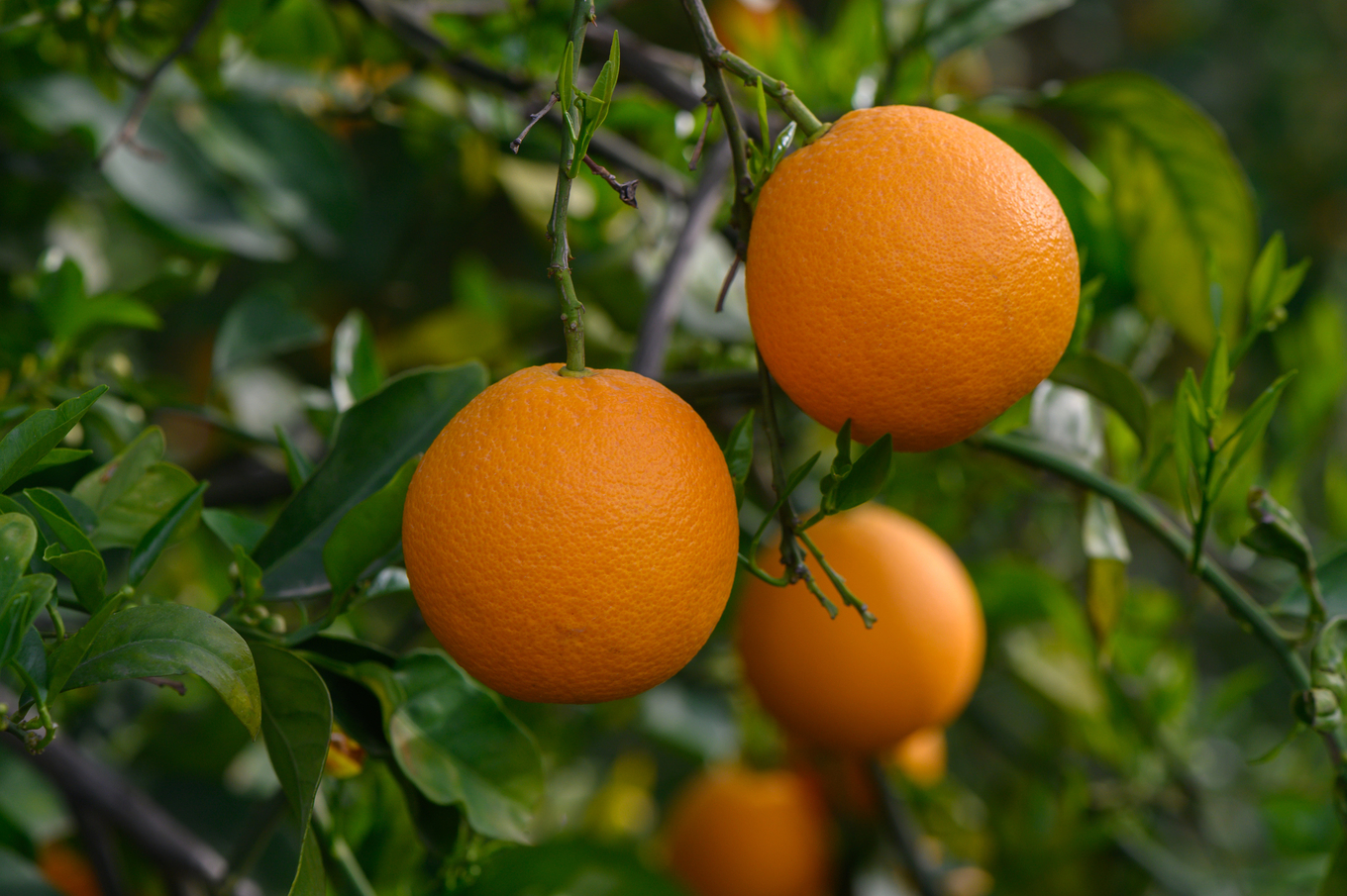
Orange juice adds a fruity sweetness, gentle acidity and familiar citrus character to cocktails. Less acidic than lemon or lime juice, it can be used in larger measures, adding body and flavour while also diluting a cocktail's alcoholic strength. Orange juice is key to numerous classics, including the Bronx, Blood and Sand, Harvey Wallbanger and Screwdriver.
Oranges are broadly classified into two groups – sweet and bitter. Bitter oranges (Citrus aurantium) are used to make jam/marmalade and to flavour liqueurs and gins. Sweet oranges (Citrus sinensis) are suitable for eating or juicing for cocktails. Popular varieties include:
- Valencia oranges – prized for their abundant juice and well-balanced sweetness and acidity.
- Navel oranges – can develop bitterness after juicing due to the formation of limonin, a naturally occurring compound, making juicing immediately before use even more crucial.
- Blood oranges – distinguished by their red-pigmented flesh, produce juice with a striking colour and often subtle berry-like flavour. Their juice can add an interesting dimension to cocktails traditionally made with Valencia or Navel oranges.
The role of orange juice in cocktals
The relatively high natural sugar content of orange juice means that it plays a different role in cocktails than lemon juice
and lime juice. While it contributes some acidity, it often benefits from the addition of a sharper citrus juice to achieve a balanced ccocktail (see "Bartenders against orange juice" below). Orange juice can also soften the more assertive characteristics of spirits and bitter aperitifs.
How to juice oranges
The best cheap juicers are the hand-held hinged type that bartenders tend to call "Mexican elbows" (Mexicans don't). Department stores sell these in various colours and sizes, orange for oranges and yellow for lemons. Cut the orange along its equator (not pole to pole) and place it, cut side down, in the bowl of the press.
Alternatively, a lever-action pillar press, such as those made by Hamilton Beach or Olympus (formerly called OrangeX), is by far the best tool for squeezing citrus fruit at speed.
Whatever juicer you use, place a fine strainer over the container catching the juice to remove unwanted pulp. If not strained out, the pulp occupies a surprisingly large volume, so measuring unstrained juice means you are slightly under-measuring your lemon juice.
I place coloured silicone wrist bands around small shaker tins for each juice – green for lime, yellow for lemon, and orange for orange. When needing juice for a cocktail, I squeeze a few fruits at a time, placing the appropriate coloured tin with a Coco Fine Strainer under a Hamilton Beach 932 Commercial Manual Citrus Juicer. While making cocktails, I continually squeeze fruit to replenish each tin as required.
Fresh is best!
Freshly squeezed orange juice is best used immediately after extraction, as its delicate aromatics deteriorate quickly once exposed to oxygen. The minute you cut open the fruit, enzymes, mainly pectin esterase, cause loss of cloudiness, changes in mouthfeel, and deterioration of flavour. The high sugar content causes bacteria, yeasts, and moulds to grow rapidly and produce off-flavours. Orange juice can lose up to 90% of its nutritional value if left to stand for 24 hours.
If you have to juice in advance, refrigerate it in a sealed container for hours, not days, before use.
Commercially produced orange juice varies considerably in quality, from juice made from concentrate to minimally processed, not-from-concentrate products. Pasteurisation and storage alter its flavour, and while good-quality packaged orange juice is a convenient alternative, freshly squeezed juice generally brings greater vibrancy and aromatic complexity to a cocktail.
Bartenders against orange juice
There is a disregard for orange juice by some bartenders. As Jeffrey Morgenthaler identifies in his article entitled OJ Is Guilty. The Case Against Orange Juice in Cocktails from January 2014, "OJ has many strikes against it...after it's squeezed, it turns bitter too quickly to be viable in high-volume cocktail operations. Worst of all, it doesn't bring much in the way of flavor." He then goes on to identify just what these drinks need.
"The problem with orange is that it's already balanced between sweet and sour, so it needs to be combined with additional sweet-and-sour ingredients to keep the drink from being thrown off balance."
Many modern bartenders find vintage recipes using orange juice imbalanced, saying recipes from the early- to mid-20th-century books are somewhat flat. Jeffrey Morgenthaler suggests avoiding the pitfalls of orange juice by using it as an additive to other sours rather than a mixer itself.
Many bars balance the orange with lemon or lime juice and sugar syrup. Others "acid-adjust" orange juice by adding food-grade acids (typically citric and malic acid) to raise the acid to match the tartness of lemon or lime juice, while keeping its orange flavour.
Everything you need to know about orange juice
Oranges originated in southern China, northeastern India, and perhaps southeastern Asia. Surprisingly, although they are thought to have been cultivated by the Chinese as early as 2500 BC, there are no early Middle Eastern or Greek references to them, but they do appear on the coinage of ancient Judea (now the West Bank) in about 142 BC.
The bitter orange was introduced to Italy by the crusaders in the 11th century and was grown in the south for medicinal purposes, and the sweet orange came to the Mediterranean in the late 15th century with Italian and Portuguese merchants. By the 17th century, the sweet orange was well known throughout Europe.
The sweet orange was then taken across the Atlantic by Spanish explorers. On his second voyage in 1493, Christopher Columbus took seeds of oranges, lemons, and citrons to Haiti and the Caribbean. Subsequent expeditions in the mid-1500s brought sweet oranges to South America and Mexico.
These regions, which are warm and sunny with plentiful rain, proved to be the perfect growing environment for oranges and even today they are the world's largest orange producing areas. Brazil currently has the greatest production, followed by the US - between them they produce over 40% of the world's citrus. Citrus will grow well in tropical, subtropical and Mediterranean climates and are found in more than 100 countries. Spain is the biggest European producer.
Health & Nutrician
Orange juice is high in sugar. with a 250ml serving typically containing 22g of sugar and 110 calories (similar to cola). However, fresh orange juice is loaded with vitamin C – one orange a day can pretty much meet your recommended daily allowance. Oranges are also rich in potassium, folic acid, vitamin B6 and thiamine. Minerals found in orange juice include copper, phosphorus, sulphur, potassium, sodium, iron and calcium.
Cocktails with orange juice
See 450+ cocktails with orange juice.
See cocktails with blood orange juice and our selection of the 20 best Blood red orange cocktails.







