


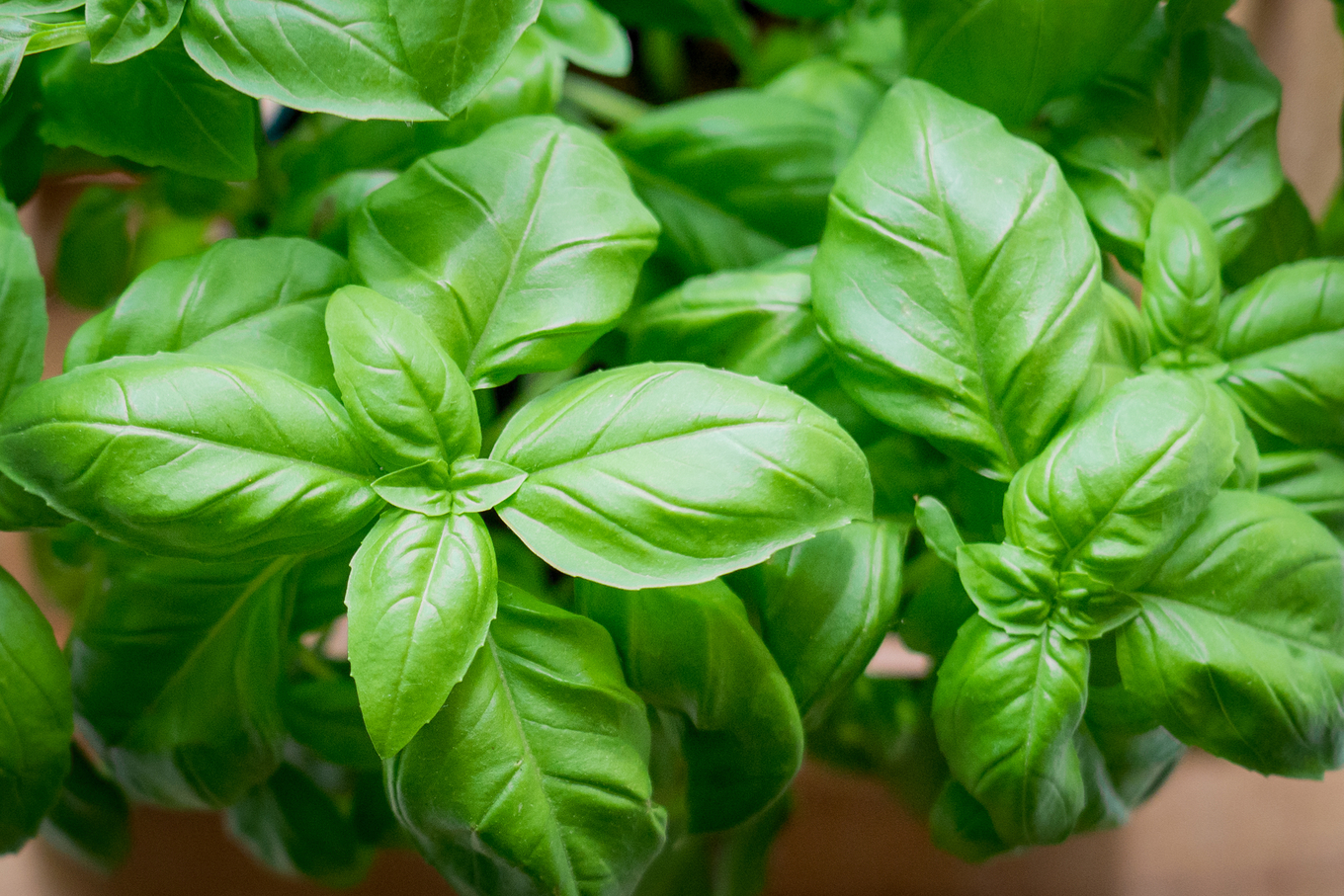
The generic term "basil" usually refers to Genovese basil, or sweet basil (Ocimum basilicum), the type most used in European kitchens and cocktails. Its broad, glossy green leaves have a sweet, herbaceous aroma with peppery and faintly clove-like notes.
Another variety of sweet basil, Genovese basil (Ocimum basilicum), is particularly associated with Italian cuisine and making pesto. Its large, fragrant leaves are also suited to cocktails.
Other styles of basil, such as Thai basil (Ocimum basilicum var. thyrsiflora), are distinctly different from sweet basil and are treated as unique ingredients on Difford's Guide.
Using basil in cocktails
Basil has a particular affinity with strawberries, raspberries, watermelon, peach, pineapple, cucumber, tomato and citrus fruits. Its more savoury characteristics also lend themselves to cocktails incorporating black pepper, balsamic vinegar and olive oil.
As with mint, bruising basil leaves helps release their aromatic oils. However, basil can withstand more vigorous muddling than mint, and in some cocktails, notably the Gin Basil Smash, thorough muddling is desirable to extract both flavour and colour.
Merely adding basil leaves to a shaker and relying on the ice during shaking does not release nearly as much aromatic oil as muddling the leaves before shaking.
Unlike mint, which has a bitter stem, basil leaves don't need to be picked from the stem, and muddling entire sprigs saves time and adds to the flavours imparted to the cocktail.
Shaken cocktails with basil should be fine strained to remove small leaf fragments. Basil may be incorporated into cocktails by infusion with syrups, spirits or vermouths, or even blended in with the other ingredients.
Fresh basil is preferable to dried basil in cocktails, the latter lacking much of the vibrant aromatic character of the fresh herb.
As with mint, reserve the most attractive leafy tips for garnishes and use the larger, less aesthetically pleasing leaves for muddling as an ingredient.
Basil as a garnish
Like mint, basil adds aroma and visual appeal when used as a cocktail garnish. A small sprig or an attractive individual leaf positioned close to the drinker's nose can considerably enhance the perception of flavour.
Large basil leaves also look good floated boat-like on a cocktail's surface.
Growing and storing basil
Basil is a relatively easy herb to grow, although, unlike mint, it favours warm, sunny conditions and is sensitive to cold and frost.
Basil thrives in well-drained soil, watered regularly but suffers if its roots become waterlogged. If growing in a pot on a windowsill, then stand the pot in water rather than watering from above. Pinching out the growing tips encourages the plant to branch, producing a bushier plant and a more plentiful supply of leaves.
Removing developing flower heads helps prolong leaf production, although the flowers themselves are edible and can be used to garnish cocktails.
Sweet basil is particularly sensitive to low temperatures, and refrigeration can cause its leaves to blacken. Freshly cut basil is generally best stored at cool room temperature, with its stems trimmed and stood in a glass of water, much as you would a bunch of flowers.
Wash basil gently in cool water shortly before use and take care not to bruise the leaves unnecessarily.
Cocktails with basil leaves
Basil has been used by chefs for centuries, but its prominence as a cocktail ingredient is relatively new and owes much to Jörg Meyer and his creation of the Gin Basil Smash, one of the most popular modern classics.


Comments & Discussion
No comments yet.