
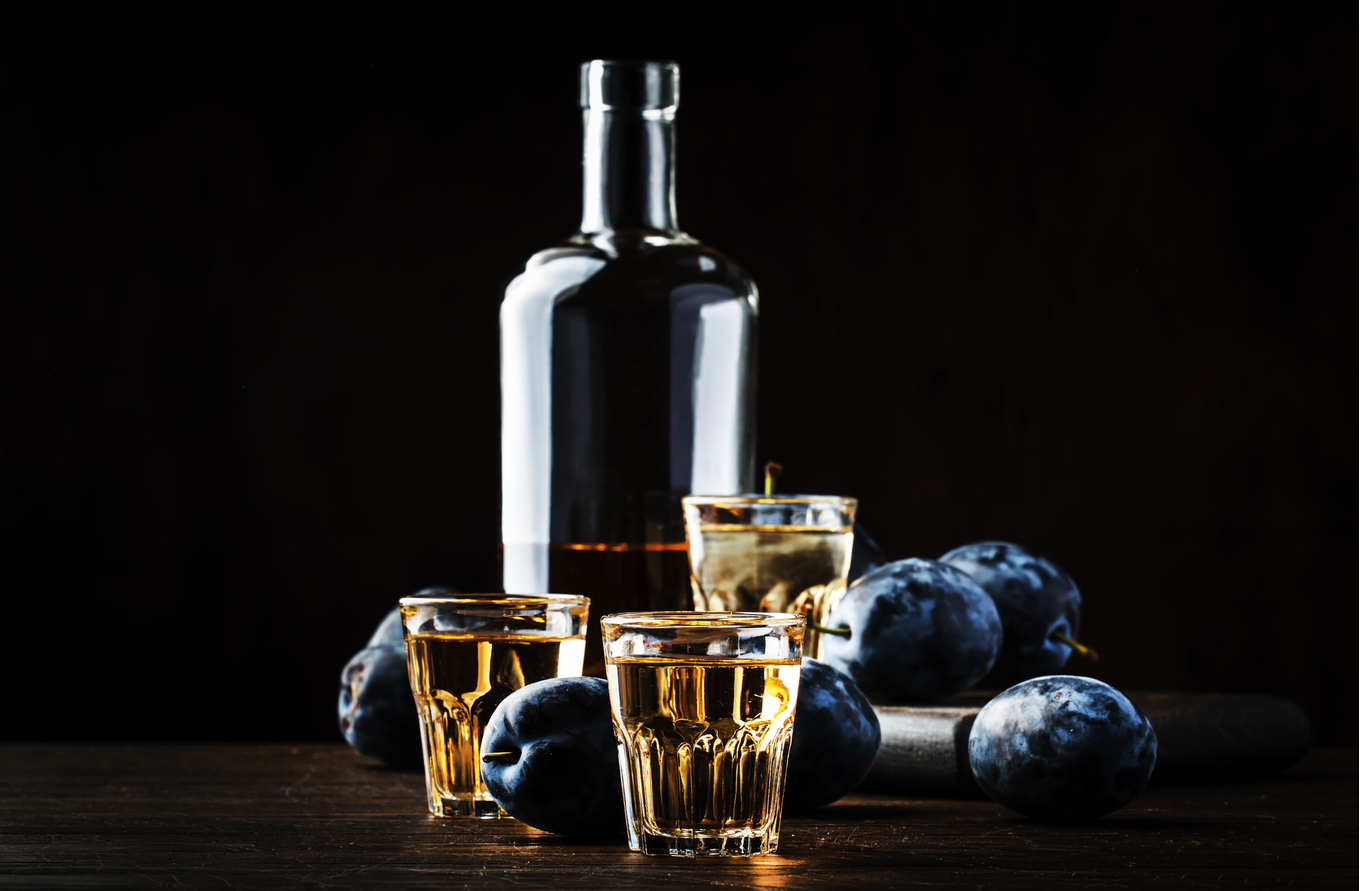
Slivovitz is a brandy/eau-de-vie distilled from crushed and fermented plums ('quetsches' in French), which is also spelt slivovitsa, slivowitz, slivovica, śiwowica, slivovice, sliwowitz, sligovica, sliboviţă or slivovka depending on which of the Balkan countries you're in.
It is usually termed a "plum brandy" or 'plum eau-de-vie' except that in the Balkans, fruit brandies are termed 'rakia', and in Hungary, fruit eaux-de-vie are called 'pálinka'. The word Slivovitz derives from the Slavic word for damson plum, 'sliva' and the term for brandy 'vice'.
Like all stone fruit, the plum kernel contains amygdalin, and if the stones are broken while the fruit is being crushed, this can give an unpleasant bitter almond flavour and release harmful chemicals such as prussic acid and ethyl carbamate. However, if unbroken stones are added to the mash and/or the distillation, then desirable flavours of almond and marzipan can be imparted to the distillate. (For health reasons, let alone flavour, the percentage of any crushed stones must be less than 1.5 per cent.)
Due to the acidity of plum fruit being 3.8 to 4.0, the pH is often lowered to 3.2 by the addition of sulphuric or phosphoric acid prior to fermentation. Ideally, fermentation should be carried out at a low temperature (16-20°C) and last for a couple of weeks. Distillation may immediately follow fermentation, but spätbrand (late spirit) is produced by distilling fermented juice (mash) which has been rested for a period, and this commands a premium.
Slivovitz is usually double-distilled in pot stills, and careful attention must be paid to the separation of the heads and tails to ensure methanol and other harmful/bad tasting substances are removed. Unusually for a fruit brandy, slivovitz is aged for 3 to 12 years in oak, robinia, and mulberry casks to mellow the spirit and give it an amber hue.
Some of the best examples of slivovitz come from the former Yugoslavia, where it is made from Pozega plums taken from trees that are at least 20 years old. The plums are fermented for several months before being double-distilled with the fruit's kernel to impart characteristically dry, almond bitterness. Primary slivovitz-producing countries are Serbia, the Czech Republic, Slovakia, Croatia, Bulgaria, Poland and Hungary. Plum brandy/eau-de-vie is also widely produced in Germany, Switzerland, France, USA and Canada.
In Bulgaria, the monks of the Troyan Monastery in the village of Oreshak have been distilling slivovitsa from Madzharkini plums since the monastery was founded in the 14th century. Another noted European producer is the Czech distillery Rudolf Jelinek in the town of Vizovice.
Since September 2007, the European Union has allowed producers in certain countries to use the generic name 'slivovitz' instead of their country of origin. For example 'Serbian Slivovitz' (Srpska šljivovica), Croatian Šljivovica and Slovenian Slivovka.
Slivovitz is 40 to 50% alc./vol. and has a rich, cooked plum and almond flavour with clove and vanilla. In the Balkans, it is usually served neat at room temperature in a small shot glass known as 'panák' (literally 'dummy'), 'kalíšek' (small cup) or 'štamprle' (little glass).
Sort by:

Schladerer Zwetschgenwasser
Category: Spirits
Sub category: Brandy (eaux-de-vie, cognac, armagnac, rakia etc.)
alc./vol: 42

Schladerer Mirabell
Category: Spirits
Sub category: Brandy (eaux-de-vie, cognac, armagnac, rakia etc.)
alc./vol: 42

Tesla Šljivo
Category: Spirits
Sub category: Brandy (eaux-de-vie, cognac, armagnac, rakia etc.)
alc./vol: 42

R. Jelínek Slivovice Zlatá
Category: Spirits
Sub category: Brandy (eaux-de-vie, cognac, armagnac, rakia etc.)
alc./vol: 45

R. Jelínek Slivovice Bílá
Category: Spirits
Sub category: Brandy (eaux-de-vie, cognac, armagnac, rakia etc.)
alc./vol: 45

Badel Hrvatska Stara Šljivovica
Category: Spirits
Sub category: Brandy (eaux-de-vie, cognac, armagnac, rakia etc.)
alc./vol: 40
