


Agreed with John CARR, this is a Ginhattan.
Ends up tasting surprisingly close to a Black Manhattan or herbal Sweet Manhattan, depending on your gin and vermouth. I am currently using Guerra Rojo which IMO makes me closer to a Black Manhattan.

Weirdly good. I agree with Avery's comments about this being "balanced" but also "pulling in every direction at once", though I personally see this as a good thing. Every ingredient somehow remains distinct, but the whole is more than the sum of its parts. It's nice when a cocktail blends into something genuinely new (e.g. Last Word), but it is also nice when it creates a sort of layered sequence. This cocktail is more of the latter.
If you aren't in love with Maraschino liqueur / Luxardo I would indeed recommend adjusting the Maraschino down to about 7.5 mL or even 5.0mL (and swapping some dry vermouth for some Bianco/Blanco), but, personally, I am quite enjoying it as is.
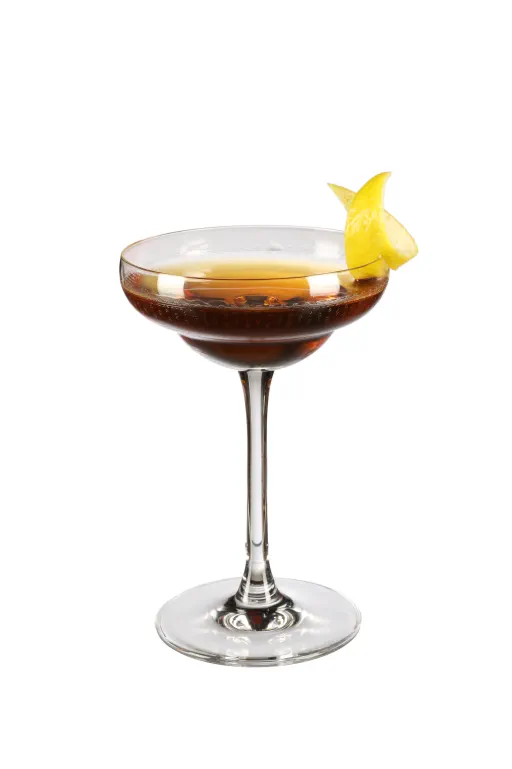
Swapping out the gin for mezcal in the various Aviation- or Creme de Violette-style cocktails is certainly sound and a no-brainer.
However, then adding Cynar and a sherry IMO creates something of an indistinct mish-mash of flavours. Not something I'd generally recommend unless you really like all the components. This cocktail isn't exactly *bad* or *imbalanced*, it just fails to justify its ingredients.


For me, 1-1 syrups win, hands down. If you are interested in why I have this opinion, read on -- sorry for the length.
Dilution with 1-1 syrups is minimal. If you use an ounce of syrup in a cocktail, (usually it's less) you are only adding 1/3 of an ounce of extra water. My admittedly limited practical experiments with side-by-side blind tastings of the same drink made with 1-1 and 2-1 syrups resulted in the two being indistinguishable by everyone I asked to try them. Maybe there are super tasters that can tell the difference, but most mere mortals can't. Also, if you are using 2-1 syrups in the cocktails where you actually want the increased dilution for some reason, adding chilled water is just an extra annoying step.
I suppose there might be some recipes that are riding the bleeding edge of dilution where the difference might be noticeable, but those are probably few and far between, and you can usually take the water out elsewhere. Anything with orange juice comes to mind, but the solution there is to acid adjust the OJ and let the extra water come out of the lime/lemon juice you don't have to use to balance the sweetness.
The real reason though is that heat is your enemy. Heating to make 2-1 syrups actually changes the sugar, and with it the flavor. Plus, 2-1 syrups aren't really shelf stable and will crash out eventually, requiring reheating to put them back into solution, further degrading the sugar.
Low/no heat syrups just taste better, IMO, particularly fruit syrups. Syrups made with 'juicy' fruits, like most berries, stone fruits, etc., can be made with no heat at all, just like oleo saccharum. Macerate the fruit and mix with sugar. Let sit for a day or so on the counter or in the fridge while the sugar pulls the juices and fruit sugars out of the fruit. Strain/filter the solids out and dilute to 50 Brix. The result is a much more intense and brighter syrup than anything heated will be. Plus you can use the solids as a spread for toast. If you try to heat these syrups enough to make them 2-1 you will cook the flavor right out of them.
Some fruits need heat for a good extraction, but adding any kind of heat at all to fruit syrups risks activating the pectin and making jelly. Cranberries will start to gel up even at 140F in a sous vide cooker, as I have repeatedly proven :-/ (They are safe at 120F). Same for rhubarb. Some fruits require a bit higher temperature for good extraction, but never above 140F. Grenadine needs some heat to get the pomegranate molasses to fully incorporate, and I make a syrup with Chinese plums, licorice and hawthorn that needs heat to speed up the rehydration of the dried fruits. Even hard ingredient extractions, like cinnamon and coconut, work better at low heat. The cinnamon flavors extracted at 140F are much more nuanced than the monotone 'red hot candy' flavor that you get at high heat. Low and slow, just like BBQ, is the ticket.
The only syrup that I make using high heat is ginger. Using pressed ginger juice or low heat extraction for ginger syrup produces a flavor that is much too sharp compared to the sweetness of the syrup, which ends up overwhelming the cocktail. The pronounced change in flavor that heating causes actually works better to create a balanced ginger syrup, IMO.
Hopefully I have convinced you that 'flavored' syrups are better with minimal heating, so 50 Brix -- but why not make your 'regular' syrups, like simple, turbinado, honey, agave, and maple at 67 Brix? For me it's just easier for all my syrups to have the same sweetness. When I'm working up a cocktail recipe, one of the first things I do is balance the sweetness. Once that is set, if I want to use the sweetener to add a flavor, I don't want the extra hassle of changing the amount required. Their shelf life is comparable, and if refrigerated, measured in months. I just don't see the advantage of 2-1 syrups.
> blind tastings of the same drink made with 1-1 and 2-1 syrups resulted in the two being indistinguishable by everyone I asked to try them
This is almost certainly true.
> if you are using 2-1 syrups in the cocktails where you actually want the increased dilution for some reason, adding chilled water is just an extra annoying step
By contrast, if using a 1:1 and you want *less* dilution, you are screwed. Also you can just shake / stir longer. So 2:1 wins here IMO.
> Heating to make 2-1 syrups actually changes the sugar, and with it the flavor.
Factually incorrect, you can make a 2:1 syrup with room temp water, you just have to be patient. And you can make a 2:1 syrup in seconds with heat that is not near enough to cause breakdown or changes to the sugar. The rest of the stuff about unheated fruit syrups is true, but completely irrelevant to 2:1 vs 1:1 sugar syrups, given this factual error.
> 2-1 syrups aren't really shelf stable and will crash out eventually, requiring reheating to put them back into solution, further degrading the sugar
Same factual error about thermal degradation, but, regardless, fridge your syrups! Then a 2:1 is basically indefinite, which is superior to 1:1. A 2:1 also takes up less space than a 1:1 in the fridge. Also, you can greatly limit or outright prevent re-crystallization with an (undetectable) pinch of salt or citric acid, if you really run into this issue.
So in short, 1:1 syrups in fact have no advantages at all ;)


Great Last Word variant; surprisingly not named after that classic but has same 3 of 4 ingredients of the Last Word (just swaps Chartreuse Green for Becherovka) and almost the same 1:1:1:1 proportion.
Came here looking for this comment. Definitely should be considered as a Last Word variant, as the notes suggest, especially given the close proportions and herbal nature of Becherovka. "Czech Last Word" was exactly my thoughts, but it is easy to overlook the notes now with the new site layout.
The cinnamon does make it a much more significant (and eccentric) variant than e.g. a Closing Argument and other closer variations, but still worth trying and quite decent IMO


The flavour combination really is excellent! I think halve the Luxardo and she’ll be right (as Australian tradesmen say). I also tried 50 gin, 20 Luxardo, but preferred 40, 30, 15.
Your modifications also produce an excellent cocktail, but a robust gin (e.g. No. 3 London Dry) or one with other notable flavors (e.g. Hendricks "Another", Drumshanbo Fig & Laurel, and I assume many others) I think can stand up to the equal-parts version. Also depends obviously a lot on the sugar content and strength of your vermouth here.
Very good, despite the slightly unhinged amount of maraschino liqueur.
John Carr's recommended modifications (as always) produce something I would think more balanced and generally favorable, but I find myself enjoying the equal parts version as well.
Best not to use a weak or middle-shelf gin, if going for the equal-parts version though.

Surprisingly excellent.
I guess I shouldn't be surprised: if you sort of squint at the ingredients, this is kind of like a white/yellow Boulevardier, in much the same ways that white / yellow / gold and etc. Negroni variants are just logical swaps on the Negroni.

A tricky cocktail, highly dependent on the Scotch and especially the Vermouth.
I've tried many variations, because the specs are so obviously sound, but I was always unhappy until I tried a variant with Emilio Lustau Vermut Blanco.
I'm in Canada, Ontario, so the selection of Bianco / sweet white Vermouths is generally abysmal, to say the least (Martini Bianco even is hard to find, and alternatives are available only at specialty Italian bottle shops, in Toronto, at huge markups). But if you find this cocktail underwhelming, I believe the vermouth is likely much of the problem. I've tried sweetening decent dry vermouths with a small amount of syrup (Guerra, La Quintinye, Dolin), and, although much improved, they were still lacking.
I finally was happy using 40mL Suntory, and 10mL Signal Hill Founders Select OP Canadian Whisky (since I sadly happened to be out of a proper Scotch), and the Emilio Lustau Vermut Blanco mentioned earlier.
I realize this is a somewhat deranged substitution, but my cabinet has run low on Scotch at the moment, and the Suntory was the closest approximation to a blended Scotch. This particular Canadian whisky contributes some sweetness and other notes, but most others would be terrible in this cocktail, given the blandness of most Canadian whiskeys.
Anyway, now that I have recognized the vermouth problem, I am looking forward to trying this with a proper blended Scotch!

Far more balanced than its ingredients would suggest, especially with a decent rye.

Pretty good, overall vaguely reminiscent of a Penicillin, somehow, probably because of the smokey, sweet, lemon and general whisky direction. But, IMO, more herbal and complex. Really growing on me as I sip.

This is a truly fantastic drink , but the comments here are a confusing mess. One mentions Cynar (???) and another claims this is "too sweet", despite the use of a rather extraordinary amount of dry vermouth relative to the Campari and Amaretto. I rather suspect that if one finds this cocktail too sweet, that such a person does not enjoy very many cocktails at all.
Although I am admittedly biased, as I love Campari and Amaretto, I suggest any curious readers to try it for themselves, as this is really a an underrated cocktail, especially given the simplicity.